Mathures Paul
Silence is golden. With every footstep along the less-treaded green grass of South Park Street Cemetery in Calcutta one discovers on headstones names that inspired mortal souls to pen works of labour. In full bloom, branches still hang low over the tombs of the forgotten.
Rose Aylmer, whom these wakeful eyes
May weep, but never see,
A night of memories and of sighs
I consecrate to thee.

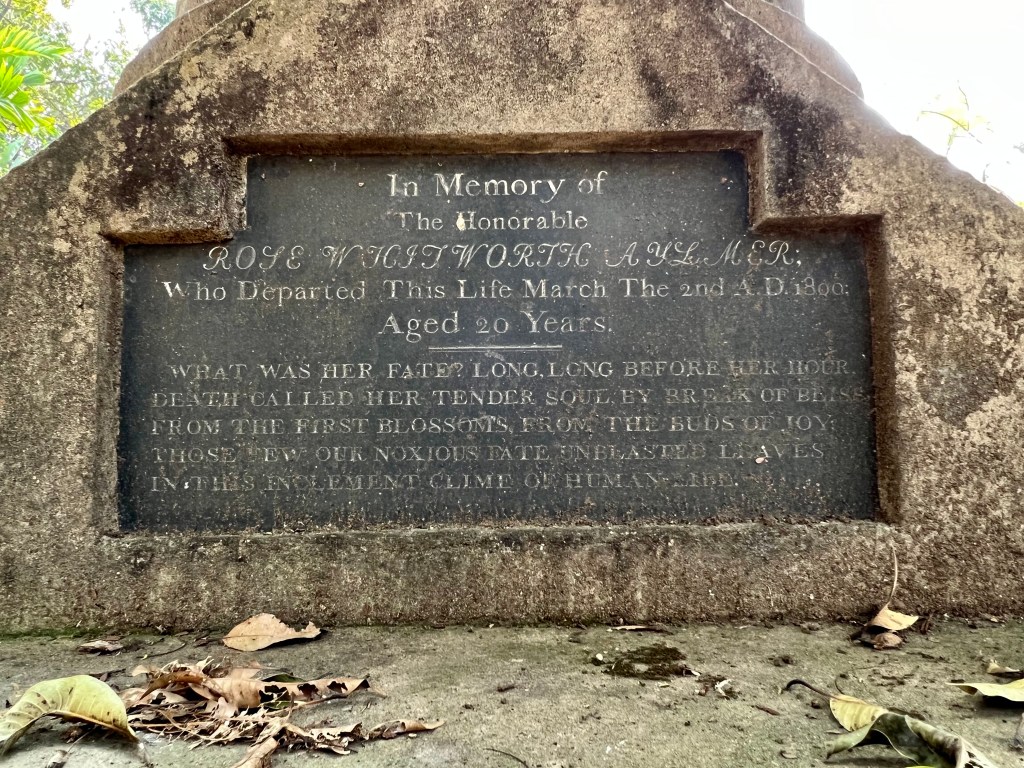
Buried in the cemetery, Rose Aylmer’s death inspired poet Walter Savage Landor to write this verse. As a 17-year-old carefree girl, Rose strolled alongside Landor on the mountains of Wales. She arrived in the city in May 1798 to join her aunt, Lady Russell (after whose husband Russell Street was named). But as luck would have it, she died of cholera a year after her arrival. Heartsick, Landor penned his elegy to Rose Aylmer that was engraved on her tomb in 1910. Even in death she remains a mystery for some. A few locals attribute her death to choking on pineapple and a few to an overdose of the fruit! Her tomb, in the design of a high shaft set on a pedestal composed of several tiers of steps, bears a simple inscription: “In memory of the Honourable Rose Whit-worth Aylmer, who departed this life 3 March, 1800, aged 20 years.”
Another corner of the cemetery has the grave of Lucia Palk, a protagonist of Rudyard Kipling’s sketch Concerning Lucia in his City of Dreadful Nights. Little is known of her. The Kipling Journal of September 1932 mentions Lucia to be the “wife of Robert Palk, daughter of the Rev Dr Stonhouse. Born in Northampton, 26th November, 1747.”
A few metres down the lane is the tomb of another memorable figure, Elizabeth Jane Barwell (died 1779). She, according to Then and Now, a publication of the Association for the Preservation of Historical Cemeteries in India, was “the famous beauty of eighteenth century Calcutta, who, as Miss Sanderson, was universally popular if we may believe contemporary reports”. It is said that at one ball she advised each of her suitors in advance of the costume she would wear. Each turned up in attires to match her dress and this resulted in 10 or 12 men wearing an identical shade of pea-green. Later, they lined on both sides of her palanquin and sang well-known tunes. Ultimately, Elizabeth married Richard Barwell.
Speaking of women who have inspired poets and writers, one must not forget to mention a book — The Bevy of Calcutta Beauties: A collection of poems. It was printed by Daniel Stuart in 1785. Penned by a mysterious poet, the collection has 18 poems, 16 of which are on women who were the toast of the town known as Calcutta.


Leave a Reply